
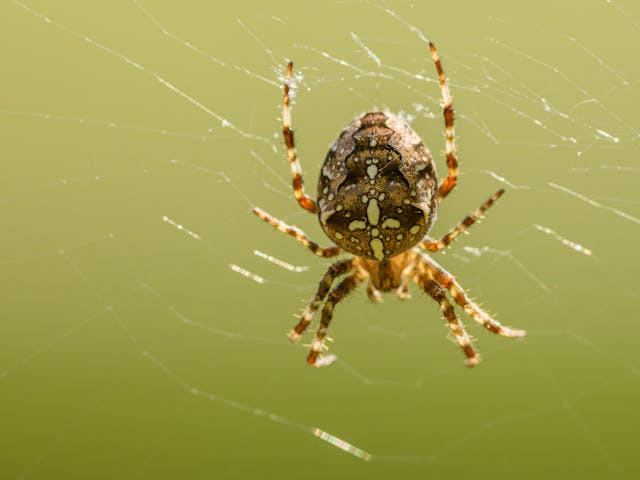
If it feels like Coeur d'Alene has more spiders than just about anywhere, you're not imagining it. Between the forests, the lakes and rivers, and our older homes, North Idaho is about as spider-friendly as it gets — and for a few weeks each fall, they all seem to head for your house at once. Here's why.
It starts with the water and the woods
Spiders go where the food is, and their food — flying and crawling insects — explodes anywhere there's water and vegetation. Lake Coeur d'Alene, Hayden Lake, the Spokane River, Fernan, and the wooded draws around Tubbs Hill and Canfield Mountain all pump out insects through the warm months. More bugs means more spiders, and homes backing up to that habitat feel it the most.
Warm exterior walls and bright porch lights make it even better: lights draw insects at night, and the insects draw spiders that build webs right where dinner shows up — your eaves, doorways, and window frames.
The fall invasion (September–October)
The big surge comes when nights start cooling off. Spiders that lived outside all summer — hobo spiders, wolf spiders, and house spiders — start looking for somewhere warm to ride out the cold. Your foundation, garage, crawl space, and the gaps around doors and vents are exactly what they're after. That's why so many CDA homeowners suddenly see spiders indoors in early fall even though nothing else changed.
Homes along the wooded edges of CDA — backing up to Tubbs Hill, Canfield Mountain, Fernan, or the lakeshore — see the heaviest fall spider pressure. More cover and more insects nearby means more spiders working their way toward your foundation.
Why lakefront and dock homes get it worse
On the water, it's a different cast of characters. Big “dock spiders” and orb-weavers string webs across railings, boat lifts, and the underside of decking, feeding on the clouds of midges and mayflies that come off the lake. If you're on Lake CDA or Hayden Lake, see our dock spider treatment page for the water-safe approach.
What you can do to keep spiders out
- Knock down webs and egg sacs as soon as you see them — that removes the next generation, not just today's spiders.
- Swap white exterior bulbs for yellow “bug” lights, or keep lights off when you don't need them, to draw fewer insects.
- Move woodpiles, bark mulch, and clutter away from the foundation.
- Seal gaps around doors, dryer vents, and utility lines, and add door sweeps.
- Trim shrubs and grass back from the house so spiders have less cover.
When to call a pro
DIY helps, but spiders keep migrating in from the yard, so the lasting fix is a barrier treatment timed for late summer and early fall — right before the indoor push. That's the heart of our spider control in Coeur d'Alene: we remove the webs and egg sacs, treat the perimeter, and keep them from getting back in. Call or text (208) 405-0004 for a free quote.
Frequently asked questions
What months are spiders worst in North Idaho?
Late summer and fall — roughly September and October — are the peak. As nights cool, hobo, wolf, and house spiders move toward warm foundations and slip indoors. A barrier treatment timed for late August into September is the best way to get ahead of it.
Are the hobo spiders in Coeur d'Alene dangerous?
Hobo spiders are common across North Idaho, and their reputation is worse than the reality — but understandably, most people just don't want them in the house. The fix is removing them and sealing the cracks and gaps they use to get inside.
Why do I suddenly see spiders inside when it gets cold?
Spiders that spent the summer outdoors look for warmth as temperatures drop, and your foundation, garage, and crawl space are inviting. Sealing entry points and treating the perimeter before fall keeps them outside where they belong.